The Android application I'm developing needs sound, unfortunately I couldn't get sound to work!
How to check sound: The easiest way to test whether you have sound working is to click on the volume buttons (right-hand side of the emulated phone). Another way to check if something is wrong is the message "using stubbed audio hardware" in the startup log. My solution doesn't remove this line though.
Failed attempt using symlinking: My pc runs Linux (Gentoo) with Alsa sound support. The emulator searches for /dev/eac which is not present on my system, so the first thing to do was to make a symlink to /dev/dsp. This failed, but I'm not excluding this method might work. Let me know if you succeeded.
Solution using OSS audio: start the emulator with the following options:
./emulator -audio oss
OSS is the older audio stack for Linux, I'm surprised it worked but hey, at least I can continue developing now!
Just an update on cloudwatch.net uptime: the hosting is back at my place but now we're renovating which does bad things to the fulltime availability of electricity. And did I mention the telephone cable was ruptured (so no ADSL for a few hours)? Nonetheless I expect the worst to be over.
In other news, I've been developing an Android phone application which will connect to the cloudwatch.net website and alert you on cloud status - without you needing to turn on a pc! Since most of the android-capable phones will have wifi this will not cost you in mobile data charges.
There's also a new cloudwatch sensor on the market, have a look at AAG Cloudwatcher. It should cost 300 euro or less. I'm looking into providing support for this sensor, input from people actually owning one is appreciated (I'm also still looking for boltwood sky sensor owners)
Good news, the cloudwatch.net website is back online. It's a temporary hosting solution, because my internet is still not fixed. I put the server at my parents' place :)
Practical announcement: - I'm moving on friday the 4th of july. This means some cloudwatch.net downtime! Minimal downtime is from 08:00 UT on 04/07/2008 to 15:00 UT on 04/07/2008. This is presuming the internet connection switch goes as expected. I would not be surprised to be out the entire weekend.
Unpractical thoughts on this: This means my testing webcam in Ghent will move as well, to Aalter. I've found someone else who seems willing to run a webcam in Ghent, only problem left to solve is the power bill of having a PC on all the time. For me it's not an issue because my server is also hosting the cloudwatch website and some other sites. Leaving a pc on only for a webcam is a bit pricey (someone care to do the measuring and math? I've heard 20/30 euros a month).
Which brings me to something I'd like to check out: buy an USB enabled router, install some open source router firmware on it and use it to host the webcam. It's been done before so should be no problem, and it solves the power bill. And everyone needs a router, might as well take one with a USB port. The Asus WS-500g looks like the most promising candidate, in combination with openwrt.org firmware. Most linux-supported webcams will then also work with this router. Contact me for more info if you'd like to try it yourself.
On a positive note, my new location should feature less light pollution, and a garden with lots of place to build an observatory. After all, what's a cloud detection system without an observatory ;)
Edit: as expected and totally in line with various laws of nature, moving the internet line to my new house has proven to be harder than moving desks, computers and mattresses. I'm hoping cloudwatch.net will be online later today. But I'm not counting on it...
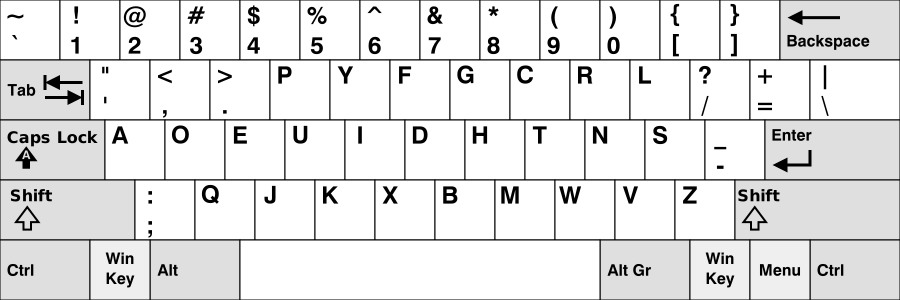
Below you can watch a youtube video about the keyboard (looks a bit cheesy but gets the point across).
First a bit of theory: the basic premise of the Dvorak layout is that the home row (the one your hands rest upon) is more used than the other rows/keys. This makes your fingers travel less distance to the hard to reach keys because most of the time you'll be typing on the home row. Result: more efficient typing.
One of the criticisms on the Dvorak keyboard is that there is no conclusive proof of its superiority. Now I can tell you it really is better than Qwerty typing, but then you'd have to believe me.
So I present two pieces of evidence: - someone searched for an efficient keyboard arrangement using a genetic algorithm and found something similar to dvorak. - the second evidence is my own: I took a picture of my keyboard after a few years of use.
On the left side you can see the picture of my TypeMatrix, which has an extra keyboard 'skin' which prevents dirt and dust to get between the keys.
Pay attention to the shiny bits, which is where the skin is worn from usage. As expected, the home row is heavily used, as is the backspace and enter and the space.
For people suffering from hand/wrist injuries the lessened travel distance is a benefit; for those hunt and peck typists it's also a golden opportunity to learn touch typing. I learned dvorak on a qwerty keyboard with a printout of the dvorak layout in front of me. Peeking at the keys didn't help me at all! In one month I could touch-type and I haven't looked back since.
Given the investments of many people in Qwerty typing, I'm not saying you should switch. If you spend entire days typing, you should at least consider it though.
Here are some links to explore further: Dvorak zine, helping you to convert US Dvorak layout in SVG format, you never know how big you need to print it :)
I started this blog as a way to do regular braindumps about hobbies and my main site (cloudwatch.net).
Now, in order to detect clouds at night (which is what the main site is all about) you need a webcam pointed to the sky. It seemed kind of a waste not to use the webcam during the day! The linux webcam capture software motion was used to gather the images, and then I wrote some scripts on the server to make one timelapse movie every day.
Yes this takes some space, but an average movie of 24h takes about 33Mb of space. I take a picture every 10 secs, so that's 8640 pictures a day. Making a movie with 24 frames per second, you get a resulting movie of 6 minutes.
Alerted by some web post that a rainbow was seen in Ghent at the 26th september 2007, I went back into my archive of movies and looked at it. No luck with the rainbow, but it does show a very eventful day. And it shows how my timelapse cloud movie looks as well :)
Every time the earth is in a specific location of its orbit around the sun, people start making lists. End of year lists they call it.
Mostly an annoying phenomenon, but not when they list the top astronomy pictures of 2007!
If you're looking to brighten up your computer desktop with some astronomy related wallpaper, this is the top 12 from the famous Astronomy Picture of the Day website (worthy of a daily visit!): Astronomy pictures of the year 2007